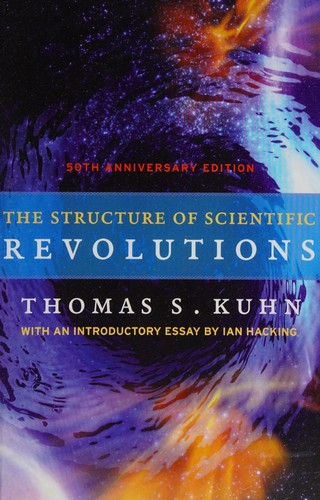
The Structure of Scientific Revolutions
Thomas S. Kuhn
33 people recommended it in 19 threads, 2007–2025.
What people on Hacker News said
One suspects that something like a paradigm is prerequisite to perception itself. What a man sees depends both upon what he looks at and also upon what his previous visual-conceptual experience has taught him to see.
That (wrt Kuhn) has made the difference between thinking of paradigms as "big-picture stuff that changes every so often in a manner more complicated than we normally consider", to seeing the tendrils everywhere, all the time, in subtle and nuanced ways propagating through all culture.
Before, I'd thought of science as absolute truths about the universe which we could only discover, linearly. Afterwards, I learned that science is as much a political process as any other major institution, that scientists are not immune to human psychological biases, that the process of getting scientific theories accepted is just as subject to selection bias ("the old generation dying out") as the things it studies, and that science is effective to the extent that it acknowledges these biases in a way that faith does not.
And on Amazon
One of the Most Influential Books on Knowledge Ever Written
The Structure of Scientific Revolutions fundamentally changes the way one thinks about knowledge, progress, and intellectual certainty. Rather than portraying science as a smooth accumulation of objective truths, Kuhn argues that scientific understanding advances through disruptive shifts in worldview—moments when existing frameworks can no longer adequately explain reality and are replaced by entirely new paradigms. What stands out most is how broadly the argument extends beyond science itself. …
Diana Paraskevas · verified purchase · 5/5
Historically, scientific progress has often involved abandoning or reconceptualizing previous ideas and observations.
Science is not a purely additive process. New facts and theories are not simply added to the pile of existing ones. New knowledge and understanding often requires abandoning or drastically reconceiving old theories and observations. Kuhn explores this in great detail, and I found it fascinating and insightful. For example, prior to the invention of the telescope, the celestial sphere was viewed as fundamentally different from the earthly sphere. But a simple look at the moon in Galileo's telescope reveals it to be a body that is very similar to the Earth. It has mountains which cast shadows as the light moves across them, and so on. …
Daniel W · verified purchase · 5/5
Structure
As a whole, Kuhn's writing can often be a difficult read, but only because it is so well orchestrated that each word falls into the right place in order to provide the closest relationship between his intention and our reception. I can't recommend reading this book unless you have some understanding of scientific experimentation and research. If you fall into the researcher category, you should be required to read it. …
JWolf · verified purchase · 4/5
Where it comes up
- Reading list for those who love to learn 2009 · 5 recommendations
- Ask HN: What are the best unknown books you have read? 2020 · 4 recommendations
- Summer Reading List 2017 · 4 recommendations
- Books That Changed How I Hear Music 2022 · 3 recommendations
- Ask HN: Best Philosophical Books? 2010 · 2 recommendations
- Ask YC: favorite books 2007 · 2 recommendations
- AI Engineer Reading List 2025 · 1 recommendation
- St. John’s Reading List: A Great Books Curriculum 2023 · 1 recommendation
- Ask HN: Which books have made you a better thinker and problem solver? 2022 · 1 recommendation
- Ask HN: Do you recall any book or course that made a topic finally click? 2022 · 1 recommendation
- Ask HN: Which books do you consider real gems in your field of work/study? 2022 · 1 recommendation
- Ask HN: What books changed the way you think about almost everything? 2019 · 1 recommendation
- Ask HN: What was the one book that you read and it actually changed your life? 2018 · 1 recommendation
- Ask HN: What are your favorite non-fiction books of all time? 2018 · 1 recommendation
- Ask HN: Which books have made you introspect? 2018 · 1 recommendation
- Ask HN: What books have made the biggest impact on your mental models? 2017 · 1 recommendation
- Ask HN: Books you read in 2016? 2016 · 1 recommendation
- Ask HN: What are the must-read books about economics/finance? 2016 · 1 recommendation
- Ask HN: Which book are you reading these days? 2015 · 1 recommendation