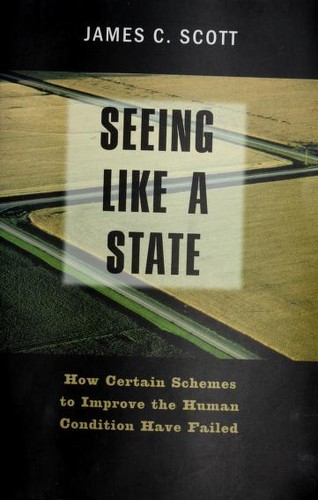
Seeing Like a State
James C. Scott
33 people recommended it in 10 threads, 2015–2024.
What people on Hacker News said
It is a beautiful book in that it illustrates how difficult it is to actually manage a country and economy well, especially if you are trying to completely change it (i.e., "develop" it, solve poverty, etc.).
“Seeing like a state” taught me what high modernism is and it’s pitfalls (since I - and I imagine many readers of HN - are already familiar with its strengths and achievements e.g. modern medicine).
top down control of a system always clashes with bottom up understanding, so experts in a field need humility when working with a new system and need to learn from the people who work with it every day.
This is oldish (1999) but full of interesting information about failed attempts at managerial systems.
The reduce of population is not the effect of the policy, but the effect of economic growth. It would have happened without the policy.
If I wanted to stop people from having children I would promote hookup culture, feminism and economically reward unstable families.
Decision-makers must rely on simplified models to make their decisions. All schemata are by nature imperfect representations of reality.
And on Amazon
How human histroy has been shaped by states to gain and manage power
I've never read a book like this, designed to rethink the way you think about the world. I thought that the world was meant to be organized and fit into neat best practices. But while there are so many ways we are better off as humanity, we often turn a blind eye to the costs of our neat and tidy representations and reformations of our world. We take what we want and turn complex ecosystems into mono-culture farms with sole optimization of productivity, decreasing resilience and efficiency while ignoring the effects of climate change. …
Emily · verified purchase · 5/5
Simplification, Granularity, and the Limits of Learning at Scale
This book delivers a powerful insight early on: modern states govern by simplifying complex reality into legible categories. The rest of the book demonstrates this same insight across case after case. The core argument lands quickly. What follows is variation rather than escalation. Scott’s claim is largely correct. To tax, conscript, and maintain order, states must compress messy social and ecological worlds into administratively manageable forms. Roads become straight lines, forests become timber inventories, farmers become standardized units, and people acquire permanent surnames. …
KN · verified purchase · 4/5
Insightful look at modernism and bureaucracy
I wasn't sure what to expect. The desire of states and organizations to make their people and resources legible inevitably results in gross simplifications that end up disastrous in practice. The in depth look at high modernism, the bureaucratic state, and absurd utopianism is extremely revealing. A good book leads to other books to buy and read, and this book is excellent.
William Johnson · verified purchase · 5/5
Where it comes up
- Ask HN: Which book can attract anyone towards your field of study? 2022 · 19 recommendations
- Ask HN: Books you plan to read in 2020? 2019 · 3 recommendations
- Ask HN: Books you read in 2022 and recommend for 2023 2022 · 2 recommendations
- Ask HN: Which books have made you a better thinker and problem solver? 2022 · 2 recommendations
- Ask HN: Books you read in 2015? 2015 · 2 recommendations
- Ask HN: What's the "best" book you've ever read? 2024 · 1 recommendation
- Ask HN: What book changed your life? 2022 · 1 recommendation
- Ask HN: What, in your opinion, are the greatest and most useful textbooks? 2020 · 1 recommendation
- Ask HN: Books you read in 2018? 2018 · 1 recommendation
- Ask HN: What books are you currently reading? 2018 · 1 recommendation